
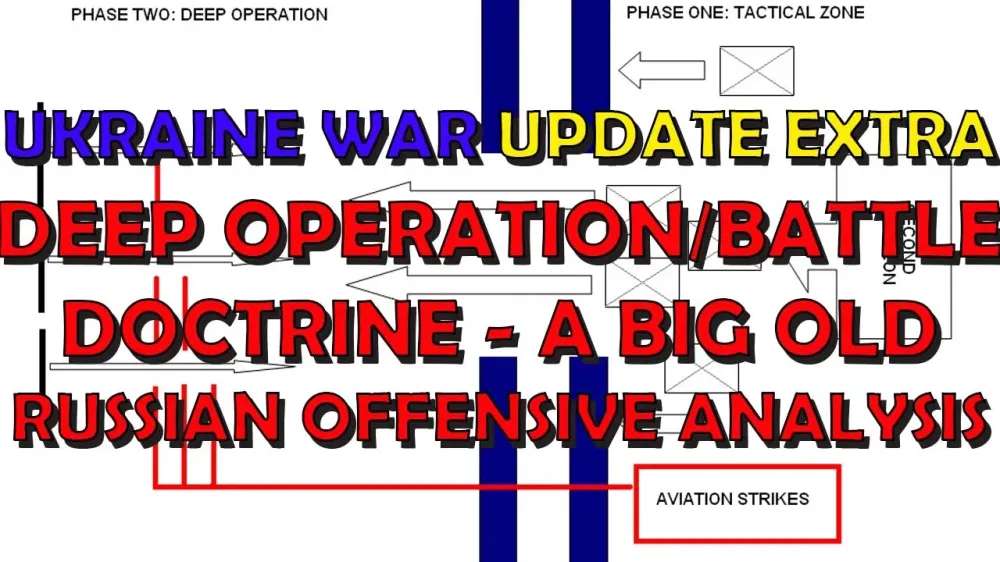
Deep Battle Doctrine - A Big Old Russian Offensive Analysis
Table of Contents 📖
| Topic ID | Topic Title | Timestamp |
|---|
"Wars are won by who's got the deepest pockets, economically speaking, and Russia don't."
Hello Team!
Jonathan discusses a Foreign Affairs article by Dara Massicot about what Russia got wrong in their invasion of Ukraine. Key points:
- Russia thought Ukraine would not strongly defend against an invasion based on polling data, but ignored data showing 84% of Ukrainians would consider Russian forces occupiers, not liberators
- Russia engaged in confirmation bias, putting more value on data supporting their intentions while ignoring contradictory data
- The West warned Russia of severe consequences if they invaded, but Russia assumed the response would be weak like in 2014 after the annexation of Crimea
Russian Military Adaptations
While wounded, the Russian military is still capable of complex operations and adaptive learning:
- The Russian Air Force (VKS) is trying to wear down Ukrainian air defences using old missiles and Iranian drones after failing to suppress them
- Russia moved command sites and logistics depots out of HIMARS range after suffering devastating attacks
- Russian forces have shown more competence on the defensive, creating layered defences that are difficult for Ukraine to fight through
- General Surovikin put defensive measures in place that put Russia in a better position, but has now been replaced by General Gerasimov, possibly due to palace intrigue rather than military failures
Deep Battle Doctrine
Jonathan analyzes whether Russia is using Soviet deep battle doctrine from the 1920s-30s in their current offensive. Key principles:
- Simultaneous offensives along the front to divert enemy attention and prevent them from sending reserves to the main objective
- Each offensive has secondary objectives but one has the primary objective
- Tactical breakthroughs are followed by mobile reserves sent to exploit the enemy's strategic depth
- Requires combined arms operations at all levels which Russia has struggled with
- Logistics are crucial to sustain deep offensives
Russian Logistical and Communications Challenges
Russia faces severe challenges with logistics and communications that hamper their ability to conduct deep battle doctrine:
- Russian truck lift capability has been decimated, with their logistics pushed back 100km from the front lines, making it very difficult to supply multiple simultaneous offensives
- Russian communications rely on insecure Chinese radios and their encrypted radio procurement was riddled with corruption
- Ukraine has systematically targeted Russian command posts, counter-battery radars, and forward observers, greatly degrading Russian artillery capabilities
- Most Russian drones lack laser targeting, requiring them to fly directly over targets, making them vulnerable to Ukrainian MANPADS
Current Russian Offensive Context
Jonathan provides his analysis on the current Russian offensive:
- Russia is probing along the front in places like Kreminna, Bakhmut, Avdiivka, Vuhledar to find weaknesses to exploit with a larger offensive
- However, Russia likely lacks the logistics and communications capabilities to sustain multiple simultaneous offensives and a larger follow-on force
- It's unclear what additional forces and equipment Russia can bring to bear that it hasn't already committed
- Ukraine is not seeing the same level of precision strikes on its rear areas that it is inflicting on Russia with HIMARS
- If this is just a probing offensive and not a major push, Russia may struggle to have enough combat power for a second echelon exploitation force
Wrap Up
Jonathan ran out of time to cover everything he wanted to discuss. He encourages viewers to read his 5,000 word article analyzing who blew up the Nord Stream pipelines. His tentative conclusion is that Russia likely did it, but the evidence is unclear and he sees valid arguments for U.S. culpability as well. He invites viewers to share their thoughts on his analysis.
Return to top⤴️