
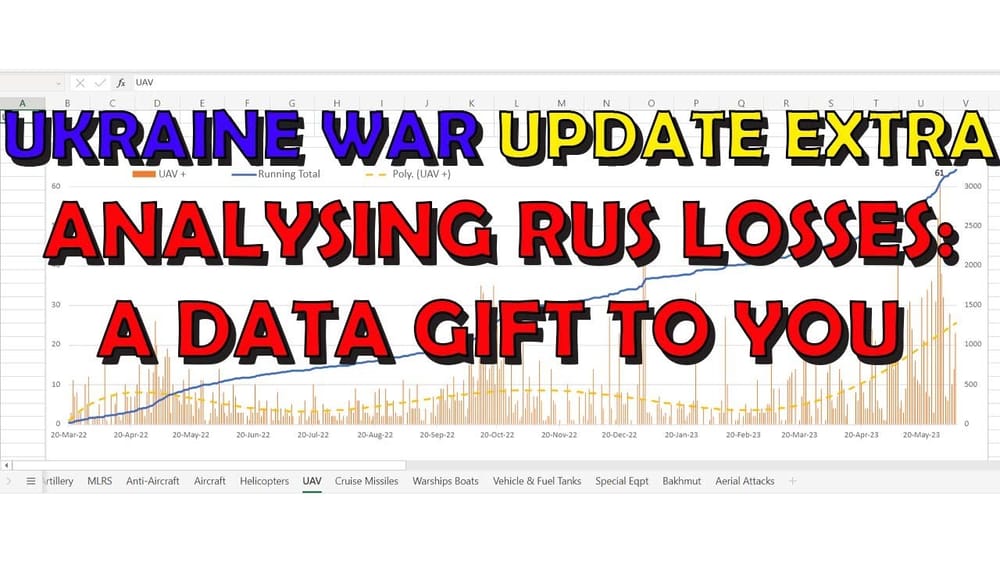
Analysing Russian Losses - A Data Gift to You
Table of Contents 📖
| Topic ID | Topic Title | Timestamp |
|---|
"Graphs, let's just do a little bit of thinking about graphs, shall we?"
Hello Team!
Jonathan introduces a spreadsheet created by a viewer named Del that compiles data on Russian losses in various categories such as personnel, tanks, armoured vehicles, etc. The spreadsheet includes graphs that visualise the data over time from March 2022 to the present day. Jonathan expresses his appreciation for Del's work in putting this together and sharing it with the community.
Return to top⤴️
Understanding the Graphs
Jonathan explains how to interpret the graphs:
- The blue line represents the overall running total of losses, which will never go down
- The yellow dotted line represents the trend, which can go up or down
- Steeper gradients indicate higher losses during that time period
- Key events like the Kherson and Kharkiv counter-offensives in late 2022 are reflected in the data
Personnel Losses
The graph shows upticks in personnel losses during the 2022 counter-offensives and in early 2023, likely due to costly battles like Bakhmut. More recently, losses have decreased as the front lines have quieted down, but there was a spike of 800 losses reported on the day of the video.
Return to top⤴️
Tank Losses
Tank losses were very high at the start of the war as Russian columns were destroyed approaching Kyiv. Spikes are also seen during the 2022 counter-offensives. However, the overall trend has become shallower recently, likely because Russia is running out of tanks and being more cautious with their use. With fewer tanks available, there are fewer for Ukraine to destroy.
Return to top⤴️
Armoured Vehicle Losses
The pattern is similar to tanks - high losses at the start of the war and during counter-offensives, with costly battles around Vuhledar in early 2023 also reflected. The trend has remained fairly consistent overall.
Return to top⤴️
Artillery Losses
Artillery losses have increased significantly in recent months. Jonathan attributes this to: 1) Ukraine making a concerted effort to target artillery ahead of their counter-offensive 2) Ukraine now having better capabilities to acquire targets with more drones and trained operators Spikes are also seen during the 2022 counter-offensives.
Return to top⤴️
Other Equipment
- MLRS losses are harder to draw conclusions from due to smaller numbers, but some spikes align with counter-offensives
- Anti-aircraft system losses have increased recently as Ukraine tries to destroy them ahead of their counter-offensive. The 2022 counter-offensives also saw upticks.
- Aircraft and helicopter losses were severe at the start of the war as Russia failed to suppress Ukraine's air defences. They became more cautious after that, using aviation sparingly, but still saw spikes in losses during counter-offensives.
- Drone losses (referring to larger drones like the Shaheed, not small battlefield drones) have increased dramatically in the last few months. This likely reflects Ukraine's improved counter-drone capabilities with systems like Gepard as well as Russia's increasing use of drones like the Shaheed.
- Cruise missile use by Russia has followed a pattern of "saturation attacks" since October 2022 to try and overwhelm Ukrainian air defences, with large gaps in between likely due to dwindling stocks and slow production. After a long gap in April, attacks have resumed at a steadier pace, possibly in line with production.
- Warship/boat losses are minimal after the sinking of the Moskva, with the Russian navy staying well clear of Ukrainian anti-ship missiles.
- Vehicle and fuel tank losses have been fairly consistent, with spikes at the start of the war and during counter-offensives. Russia may be struggling with vehicle availability.
- Special equipment (e.g. electronic warfare, demining, ISR) losses have increased dramatically in recent months. Jonathan suggests this equipment would have been less prevalent earlier in the war but Russia has since developed and deployed more, which Ukraine is now explicitly targeting, especially ahead of their counter-offensive.
Bakhmut Analysis
Del has done some analysis on Bakhmut losses and extrapolated to estimate potential Russian losses for capturing larger cities, but Jonathan has not had time to fully review this part of the spreadsheet yet.
Return to top⤴️
Wrap up
Jonathan expresses his appreciation once again for Del's work and for sharing it with the community. He encourages viewers to like, subscribe and share the video.
Return to top⤴️